How Qantra solves practical problems with RAG
Organizations are working to access their own knowledge more effectively, especially when it is scattered across technical documents, archives and ever-evolving internal sources. Our team built a multimodal RAG system that delivers reliable, sourced and actionable answers in seconds, even in the most demanding industrial environments.
In this context, our team explored how modern search and generation methods could be applied to build a system that gives direct, reliable access to complex information. The result is a proof of concept that demonstrates both the feasibility and the relevance of such an approach, particularly in demanding industrial environments.
01 — The challengeScattered knowledge that costs a fortune
In many technical and industrial environments, organizations face a growing volume of internal documentation: procedures, reports, regulations, field reports, archives. Quickly finding the right information has become increasingly difficult, even for experts.
Traditional search tools no longer cut it. They rely on exact keywords, ignore context and struggle with domain-specific language. On top of that, knowledge is spread across formats, platforms and teams, which makes it hard to access when decisions need to be made.
What is needed today is not just access to documents, but the ability to instantly retrieve relevant and actionable knowledge. Our system was built in response to that challenge.
02 — Our approachMultimodal RAG combines search and generation
The system we designed relies on a Retrieval-Augmented Generation (RAG) approach, which combines two essential capabilities: searching the existing documentation and generating answers directly grounded in those sources. Instead of producing generic responses, it uses the organization’s knowledge base to provide precise and verifiable information.
To handle the complexity of real-world documents, the system also integrates image understanding. Many technical files include diagrams, scanned pages, tables or non-textual elements that traditional search tools ignore. By integrating visual content into the search process, the system goes beyond text and brings true multimodality to knowledge access.
Adaptable, multilingual, ready for specialized domains
Another strength of the solution is its adaptability. It can operate in different languages and adjust to the terminology of highly specialized domains, such as oil & gas, energy and other industrial sectors where precision is critical. This makes it usable by diverse teams without requiring changes to existing document formats or internal processes.
Overall, the system improves access to knowledge, not by replacing the documentation, but by making it instantly searchable, interpretable and actionable across different contexts.
Multimodality changes the equation. A scanned diagram or a table image becomes indexable and queryable just like a paragraph of text.
03 — Use casesWhen RAG makes a real difference on the ground
The system is designed for situations where fast, reliable access to internal knowledge makes a real difference. It can support experts who need immediate references during technical analyses, as well as teams less familiar with complex documentation but still needing precise information.
In practice, it can be applied to tasks such as retrieving domain-specific standards, finding relevant sections in long reports, or extracting information from documents containing both text and visuals. It can also help in situations where regulatory, operational or security constraints demand clear, traceable answers.
What makes these use cases concrete is the system’s ability to generate answers directly grounded in the existing documentation. Instead of producing guesses, it delivers verifiable, reusable, shareable results that fit into real workflows.
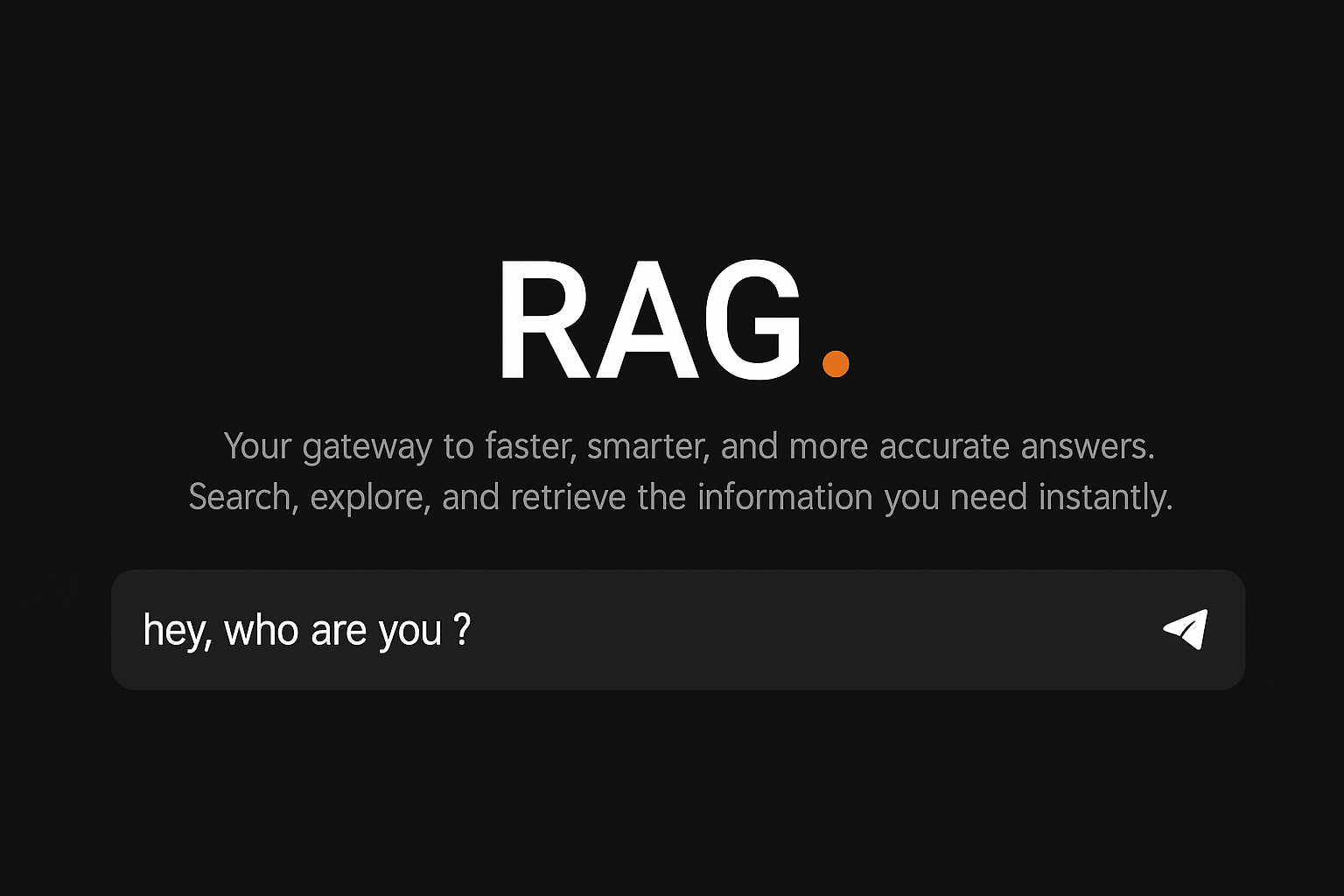
Examples of interactions and results are shown to illustrate how the system performs in real situations. The visual at the top of this article gives a snapshot of a typical session between an expert and the RAG engine: a natural-language question, a sourced answer, references to the original documents.
Source cited
04 — What we deliveredWhat the team shipped in proof, reliability and traceability
The system was tested on real internal documentation rather than synthetic data, demonstrating its ability to retrieve precise information even when the sources are long, technical or scattered across multiple formats. Its reliability comes from the fact that answers are always grounded in the existing content, allowing users to trace back to the original documents and meet compliance requirements.
The multimodal capabilities further boost its performance by integrating visual elements such as diagrams, scanned pages and tables into the search process. Early demonstrations also showed that the system can adapt to different domains and languages without rebuilding its core architecture, which makes it a credible foundation for future deployment.
Behind these results sits focused engineering work. The team invested in selecting effective strategies for processing and storing varied document types, rather than relying on a single method. Equal attention was paid to balancing latency and answer quality so the system stays both accurate and responsive. This focus on practical reliability ensures that the technology can be used in real workflows, not just demonstrated in isolation.
No synthetic data
Validation on real internal documentation, long, technical and heterogeneous. Precision measured in production-like context.
Compliance by design
Every answer is grounded in existing content. Users can trace back to the source document and audit the citation chain.
No core rebuild
Adaptable to different languages and specialized terminologies (oil & gas, energy, industry) without re-engineering the core.
05 — Next stepsToward sharper precision, better quality and scale
The system has proven effective as a proof of concept, confirming the value of multimodal, retrieval-augmented access to internal knowledge. The next step focuses on improving two key axes: search precision and the quality of generated answers.
This work is about better document indexing and intent matching, while keeping results precise and verifiable as content scales. The architecture is already extensible and integrable. The priority now is to strengthen reliability and user experience, not to rethink the approach.
Iterate in short loops with business users, measure real-world quality rather than theoretical performance, and keep a high bar on traceability.
Want to explore what RAG can do for you?
Book a free 30-minute scoping session with our team. We study your documentation, your priority use cases, your compliance constraints, and we tell you frankly whether a RAG approach is the right answer for your organization.
5-point summary
- Internal knowledge is scattered across formats, platforms and teams and remains out of reach for classic search tools.
- Our multimodal RAG combines search across the existing documentation with grounded, sourced answer generation.
- It indexes not only text, but also diagrams, tables and scanned pages, going far beyond Ctrl+F.
- Validated on real documentation in demanding industrial sectors, with a focus on traceability and compliance.
- Next step: push search precision and answer quality beyond the POC, toward scale-up.