Why your data must stay home: sovereign hosting in Algeria
In 2025, an Algerian bank sent 3,000 customer documents to an AI API hosted in the United States. Contracts, statements, ID papers, all gone in a few clicks, with no one asking the obvious question: where does this data end up?
In 2025, an Algerian bank sent 3,000 customer documents to an AI API hosted in the United States. Contracts. Statements. ID papers. All of it gone in a few clicks, with no one asking the obvious question: where does this data end up?
Six months later, an internal audit revealed that those documents had passed through four servers across three different countries. No end-to-end encryption. No traceability. This story is not an isolated case. It is the daily reality of dozens of Algerian companies today.
Sovereign hosting is no longer a luxury. It is a regulatory, economic and strategic necessity.
01 — DefinitionWhat is sovereign hosting?
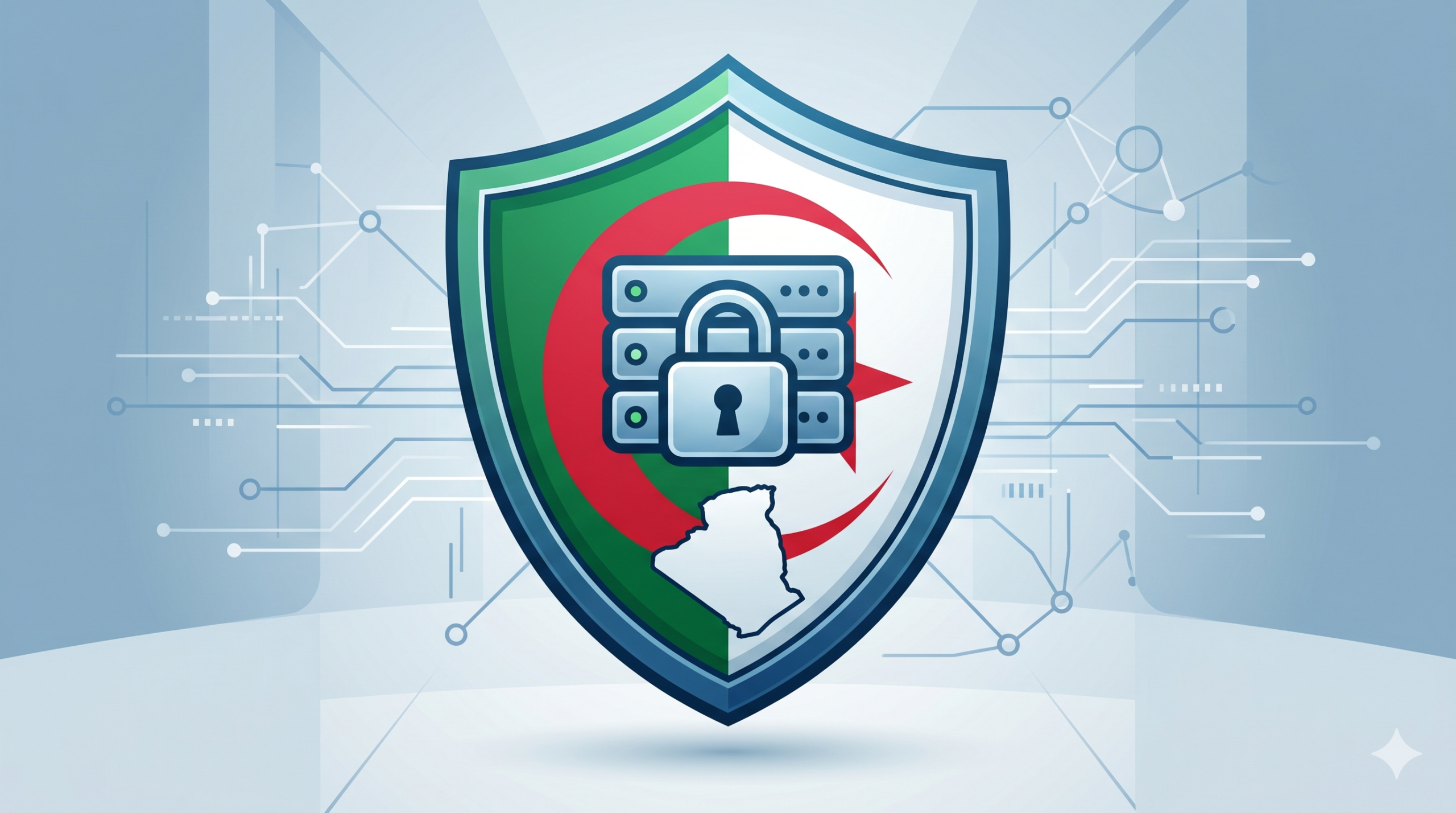
Sovereign hosting means your data is stored, processed and managed on servers located on national territory, under Algerian jurisdiction, and operated by entities subject to Algerian law.
Concretely, this implies three simultaneous guarantees:
Servers are in Algeria
Not in France, not in Ireland, not in the United States. In Algeria. You know the city, the datacenter, the country.
Algerian law exclusively
No foreign law (Cloud Act, Patriot Act, FISA) can compel a third party to disclose your information.
Full audit trail
You know exactly who accesses your data, when, and why. Every access is logged.
This is not the same thing as a “localized cloud”. A foreign provider that installs a server in Algeria still falls under the jurisdiction of its home country. Server location is not enough. Jurisdiction is what counts.
02 — Legal frameworkLaw 18-07: what the Algerian regulatory framework says
Law n°18-07 of 10 June 2018 on the protection of natural persons in the processing of personal data is the regulatory foundation in Algeria.
What the law requires
The transfer of personal data to a foreign country is forbidden unless that country guarantees a sufficient level of protection.
The data controller must take all useful precautions to preserve the security of the data and prevent it from being altered, damaged or accessed by unauthorized third parties.
The National Authority for the Protection of Personal Data (ANPDP) can prohibit a data transfer to any country that does not provide an adequate level of protection.
What this means for your company
If you use ChatGPT, Google Gemini or Claude via their cloud APIs to process documents containing personal data of Algerian citizens, you are potentially in breach of the law.
The most exposed sectors:
Compliance is not optional. It is the law.
03 — ComparisonSovereign vs foreign cloud: the honest comparison
Let us be transparent. Foreign cloud has advantages. So does sovereign hosting. Here is the comparison without spin.
Foreign cloud: 50-150 ms. Algerian sovereign hosting: under 10 ms. Geographic proximity is unbeatable.
Foreign cloud: not guaranteed. Sovereign hosting: guaranteed by design. Full audit trail and exclusive Algerian jurisdiction.
Foreign cloud: cut-off risk. Sovereign: zero external dependency. Local support, GMT+1 timezone.
Foreign cloud wins on unlimited scalability and raw performance. Sovereign hosting wins on everything else: compliance, latency, traceability, independence, local support. For 95% of Algerian use cases, the balance clearly tips toward sovereignty.
04 — MethodThe 5 questions to ask before choosing a solution
Not “in the cloud”. Where exactly. Which city. Which datacenter. Which country.
A server in Algeria operated by a US subsidiary still falls under the Cloud Act. Server location is not enough.
Ask for the exhaustive list of people and systems that can access your data. If the provider cannot give it to you, walk away.
If the answer is “we have to comply with the laws of our home country”, your data is not sovereign.
A serious sovereign provider invites you to audit. A provider that refuses to show you its infrastructure has something to hide.
05 — Qantra ArchitectureHow Qantra deploys sovereign hosting
At Qantra, we made the choice of total sovereignty from day one. Our sovereign RAG system is designed to run entirely within the client’s infrastructure, with no outbound connection to foreign APIs.
Our 4-layer architecture
On-premise deployment at the client site or on Algerian sovereign cloud. Dedicated GPUs for AI processing. Encryption at rest (AES-256) and in transit (TLS 1.3).
Optimized open-source LLMs running on the client’s servers. No request leaves the perimeter. Fine-tuning possible on business data.
Vector database hosted locally. Multi-level embeddings for precise search across thousands of documents.
Full audit trail on every query. Fine-grained access rights per user and per document. Logging compliant with Law 18-07.
Concrete results
We have already deployed this architecture in several sensitive sectors:
A drilling company now exploits 300 pages of technical documentation in 2 seconds instead of 15 minutes manually. Continuous indexing, natural-language queries, sources cited.
speed
Managers find the right procedure in natural language instead of digging through 50 binders. The full corpus stays on the bank’s internal servers.
into one assistant
40% reduction in claims processing time thanks to automatic document extraction. No piece of evidence ever leaves the insurer’s information system.
per case
Each deployment is delivered in 6 to 12 weeks, from initial audit to production rollout.
06 — PitfallsMistakes to avoid
GDPR is a European framework. It does not apply in Algeria. Even in Europe, it does not prevent the US Cloud Act from applying to data hosted by US providers.
A VPN encrypts the transit. It does not protect the data once it lands on the destination server. If that server is in the United States, your data is in the United States.
Companies that invest in sovereign hosting are not paranoid. They are prudent. When the audit hits, they sleep well.
Confusing local hosting and sovereignty. A server in Algeria managed by a foreign company is not sovereign. Sovereignty is full mastery: infrastructure + code + operations + jurisdiction.
07 — ImplementationHow to start
If you are an Algerian company handling sensitive data, here are the three steps to switch to sovereign hosting:
Together we analyze where your data flows today, what the risks are, and which use cases are priority.
We deploy a first prototype on a subset of your data, in an isolated environment. You measure the value before any commitment.
Scale-up on your infrastructure, training of your teams, production rollout. All the code stays your property. All the infrastructure stays under your control.
Your data deserves to stay home.
Book a free 30-minute audit with our team. We study your current architecture, we identify risk areas, and we tell you frankly whether sovereign hosting is the right answer for your organization.
5-point summary
- Sovereign hosting guarantees that your data stays in Algeria, under Algerian jurisdiction, with full control.
- Law 18-07 bans the transfer of personal data to countries without adequate protection.
- Foreign cloud wins on scalability; sovereign hosting wins on compliance, latency, security and independence.
- Qantra deploys sovereign AI solutions (RAG, business agents) entirely within client infrastructure.
- The switch to sovereign hosting takes 6 to 12 weeks, not years.